

Want to boost sales and increase customer value with digital product bundling? Here's what you need to know:
- What is it? Bundling combines multiple digital products (like ebooks, courses, or software) into a single package at one price.
- Why it works: It raises average order value (AOV) and encourages bulk purchases. For example, HiSmile saw 80% of its orders shift to bundles in 2025, quadrupling cart size.
- Key features to look for:
- Secure delivery to protect against piracy (e.g., DRM, expiring links).
- Customization options for branding and personalization.
- Payment integration for smooth checkout experiences.
Top pick: Platforms like Lideroo simplify bundling with no-code tools, AI-powered content generation, and analytics.
Quick Comparison:
| Tool | Monthly Cost | Transaction Fees | Best For |
|---|---|---|---|
| Lideroo | ~$42 | Included | Full customization, no coding |
| SendOwl | $39 | Included | High order volume |
| Gumroad | Free | 10% + $0.50 per sale | Beginners, low initial cost |
Bundling is a proven way to grow revenue, and choosing the right tool makes all the difference. Let’s dive deeper into the features, strategies, and tools that can help you succeed.
How to Create a Digital Bundle in 24hrs with A.I. (Make $5,377/mo)
Key Features of Digital Product Bundling Tools
Choosing the right tool for bundling digital products is a big deal. It’s the difference between securing your revenue and leaving yourself exposed to challenges that entrepreneurs face every day. Let’s dive into the features that truly make a difference.
Secure Delivery and Anti-Piracy Protection
Piracy is a massive threat to digital product revenue. Just to give you an idea, piracy websites saw a staggering 141 billion visits in 2023 - a 12% jump since 2019 [1]. For U.S. businesses, digital video piracy alone causes losses ranging from $29.2 to $71 billion annually [1].
The best bundling tools tackle this head-on with DRM systems that restrict unauthorized access [1]. These tools often include features like:
- Expiring download links that disable after a set time.
- Password protection for individual files.
- Download limits to prevent indefinite access.
To take it further, watermarking and fingerprinting embed unique identifiers in your content. While visible watermarks can be removed, invisible ones paired with encryption offer stronger safeguards [2]. Encryption scrambles file contents, ensuring only legitimate buyers can access your products.
Some platforms go above and beyond by offering user authentication and web monitoring to track unauthorized copies. Tools with built-in DMCA takedown services make it easier to remove pirated content when it’s discovered. For added security, license key generation creates unique access codes for each customer. These codes can be deactivated if misuse is detected.
But security isn’t the only thing that matters - how your bundles look and feel to customers is just as important.
Customization and Branding Options
A great bundling tool doesn’t just protect your products; it also helps you showcase your brand. Instead of being stuck with a cookie-cutter design, the best platforms let you customize the entire customer experience.
With visual customization tools, you can align checkout pages, download areas, and customer communications with your brand’s colors, fonts, and imagery. This consistency builds trust by reinforcing your brand at every touchpoint. Some advanced platforms even offer 3D visualization, letting customers see real-time changes as they tweak their bundle options [3].
Why does this matter? Because customers love personalization. Research shows:
- 76% of customers are willing to pay more for products tailored to their preferences.
- 36% actively seek out custom products.
- Personalization programs lead to a 20% boost in customer satisfaction [3].
Customization isn’t just about visuals - it’s also about making the buying process seamless. The best tools let you design user-friendly interfaces, where customers can easily pick bundle components, explore upgrade options, or add extras without feeling overwhelmed. You can even tailor product descriptions, comparison charts, and benefit explanations to match your brand’s tone.
"Product personalization, letting people customize things like banners, signage, posters, t-shirts, or even gadgets with their names, makes them feel important. It's like giving them the power to create exactly what they want." [4] - Abhishek Agarwal, DesignNBuy
Of course, even the most beautifully designed bundles won’t sell if customers can’t pay easily.
Payment Processing Integration
A smooth payment process can make or break your sales. The best bundling tools integrate with multiple payment gateways, giving customers the flexibility they need while ensuring you don’t miss a single sale.
Support for various payment methods, like mobile wallets, credit cards, and PayPal, is key to maximizing conversions. Mobile wallets alone accounted for nearly half of global e-commerce transactions in 2023 [6]. PayPal, in particular, has proven to boost checkout conversions by 28% and increase unplanned purchases by 19% [5]. Plus, 69% of users feel more confident shopping on sites that accept PayPal [5].
When choosing a platform, pay attention to transaction fees. Most major processors charge between 2.6% and 2.9% plus $0.30 per transaction for credit cards, while ACH transfers can be as low as 0.5% plus $0.25 [5]. Transparent pricing without hidden fees is a must.
To make life easier, look for tools that integrate with accounting systems like QuickBooks, automating invoice reconciliation [7]. Security is another critical factor - features like PCI DSS compliance, tokenization, and encryption protect both your business and your customers from fraud [7]. The best platforms handle these requirements automatically, so you don’t have to worry about managing compliance on your own.
Lideroo: A No-Code Solution for Digital Product Bundling
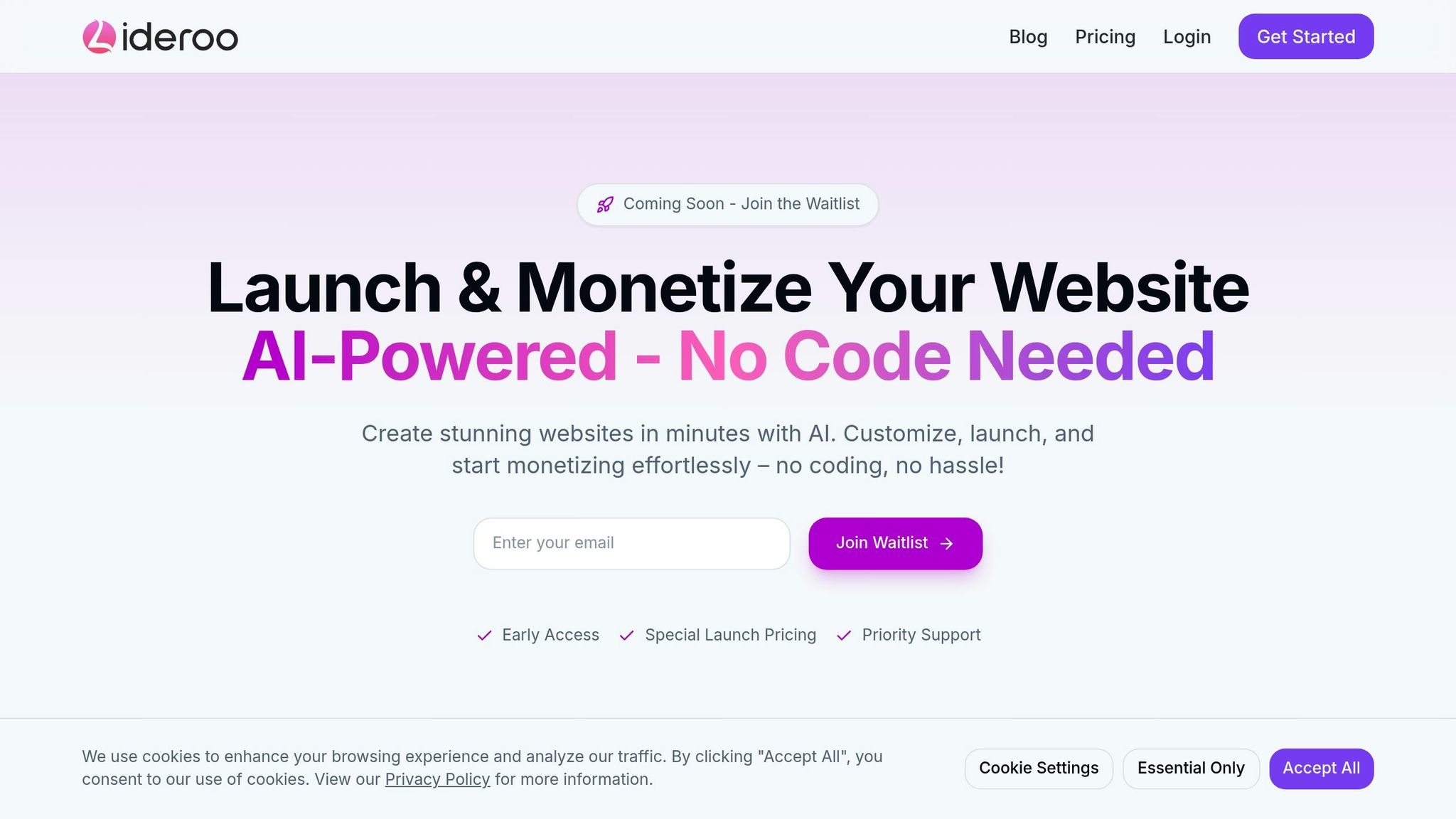
Lideroo stands out as a no-code, AI-driven platform that simplifies the process of creating, customizing, and monetizing digital product bundles. Unlike tools that demand technical skills, Lideroo offers an all-in-one ecosystem tailored for digital commerce. From setup to payment processing, everything is handled seamlessly. With secure delivery, extensive customization options, and integrated payment features, Lideroo provides the tools needed to succeed in digital bundling.
AI-Powered Website Builder
Lideroo's drag-and-drop editor makes building an online store straightforward, even for those without technical expertise. Its AI-driven content tools help generate product descriptions and landing page copy quickly, speeding up the process of launching your storefront. Pre-designed templates, tailored for digital commerce, and visual customization options allow you to match your brand’s colors, fonts, and imagery. Plus, every site is optimized for mobile devices, ensuring a smooth experience for your customers.
Built-In Monetization Features
Monetizing digital bundles has never been easier. Lideroo supports premium content strategies and subscription-based offerings, all managed through a user-friendly dashboard. With integrated payment solutions that include major credit card options, U.S. businesses can efficiently turn their digital products into revenue streams.
Analytics and SEO Optimization
Understanding your audience is essential for growth, and Lideroo delivers with advanced analytics. These tools provide insights into customer behavior and bundle performance, helping you refine your offerings. Additionally, Lideroo’s built-in SEO tools enhance your site’s visibility, making it easier for potential customers to find your digital bundles. Features like custom domains and the option to remove branding on paid plans further boost your site’s professional appeal and credibility.
sbb-itb-dfa823a
Comparison of Digital Product Bundling Tools
After diving into the essential features like secure delivery and customization, let’s now compare some of the top platforms available for digital product bundling. The right choice will depend on your business size, technical expertise, and growth plans. Here's a quick breakdown of leading tools to help you make an informed decision.
Tool Comparison Table
Here’s a snapshot of how these tools stack up:
| Feature | Lideroo (Starter) | SendOwl (Starter) | Gumroad |
|---|---|---|---|
| Monthly Cost | ~$42/month¹ | $39/month | Free |
| Transaction Fees | Included | Included | 10% + $0.50 per transaction |
| Key Features | AI Content Generation, Custom Domain | Up to 5,000 orders/year, 10 GB Storage | Tax management |
¹ Approximate value converted from €39.
Pros and Cons of Each Tool
Lideroo
Lideroo stands out as a comprehensive solution for creators who want full control over their digital storefront. With AI-powered content generation and a no-code drag-and-drop builder, it’s easy to customize your platform. Features like custom domains and built-in monetization tools make it ideal for building a strong online presence. However, the subscription cost might be a hurdle for creators just starting out.
SendOwl
SendOwl is a great choice for businesses handling higher order volumes. The Starter plan accommodates up to 5,000 orders annually and offers 10 GB of storage. It’s particularly useful for managing time-sensitive downloads and distributing license keys. On the downside, the fixed pricing can result in additional fees if you exceed the order limit [9].
Gumroad
Gumroad appeals to new creators with its no-cost monthly plan and simple setup, making it a hassle-free way to start selling digital bundles. Its transaction-based fee structure (10% + $0.50 per sale) is budget-friendly for occasional sellers. However, as sales increase, the transaction fees can become costly compared to subscription-based models, which may be better suited for scaling businesses.
These tools each have their strengths, catering to different needs and business stages. Up next, we’ll explore best practices to refine your bundling strategy.
Best Practices for Digital Product Bundling
Once you’ve chosen your platform, the next step is crafting bundles that customers truly want. The difference between a bundle that flies off the virtual shelves and one that collects dust often lies in understanding customer psychology and buying habits. Let’s break down how smart pricing and strategic planning can make all the difference.
Offer Clear Value with Discounted Pricing
Pricing your bundles effectively is all about making the value unmistakable. Customers need to feel like they’re scoring a deal while you still maintain a healthy profit margin. A study by Harvard Business School highlighted this approach’s potential - Nintendo’s mixed bundling strategy boosted sales by as much as 100,000 units in a single campaign [11].
There are a few ways to approach pricing:
- Fixed discount pricing: This method works well when you want to highlight specific dollar savings. For example, if the individual items in a bundle total $63, pricing the bundle at $49 makes the $14 savings clear.
- Percentage discount pricing: For higher-priced bundles, showing a percentage discount can feel more impactful. A 25% discount on a $200 bundle sounds more enticing than simply stating a $50 savings.
- Tiered pricing: Offering multiple bundle options can cater to different budgets. For instance, you might create a basic bundle at $39, a premium version at $69, and a full package at $99.
As Warren Buffett famously said, “Price is what you pay. Value is what you get” [10]. Your job is to make that value obvious. Take cues from customer preferences - 93% of shoppers favor Buy-One-Get-One (BOGO) bundles, according to a survey by AMG Strategic Advisors [11]. People love the feeling of getting something extra.
Use Analytics to Optimize Bundles
Your data holds the key to creating bundles that sell. Instead of relying on guesswork, use analytics to uncover which products naturally pair well. By examining customer behavior - like frequently viewed, added-to-cart, or purchased items - you can identify combinations that resonate with buyers.
For example, if customers who purchase your photography course often buy editing presets, bundling these items makes sense. Keep an eye on customer lifetime value (CLV) to determine which bundles attract the most loyal, high-value customers.
Dig into your funnel analysis to spot where potential buyers drop off in the process. If bundles are abandoned in carts, it could signal unclear pricing or a weak value proposition. Cohort analysis can also help you segment customers based on their bundle-purchasing habits, allowing for more targeted offers.
Tracking your return on ad spend (ROAS) for bundle promotions reveals which marketing messages resonate most. Modern e-commerce strategies focus on these long-term metrics rather than just cost-per-acquisition, giving you a clearer picture of profitability [13]. Regular testing and tweaking are essential - review your bundle performance weekly and adjust based on sales data and feedback. What works for one audience may not work for another, so let the numbers guide you.
Improve the Customer Experience
Even with perfect pricing and analytics, a smooth customer experience is what seals the deal. A frictionless buying process can significantly boost sales. In fact, 73% of consumers report becoming loyal to brands after a positive experience [12]. From how your bundles are presented to how easy they are to purchase, every detail matters.
Here’s how to refine the experience:
- Mobile optimization: Many shoppers will discover and buy bundles on their phones. Make sure your bundle pages load quickly and display clearly on smaller screens. The checkout process should also be simple and mobile-friendly.
- Logical grouping: Pair items that naturally complement each other. For example, a social media marketing bundle might include templates, a strategy guide, and scheduling tools. Avoid throwing together random products just to make a bundle.
- Mixed bundles: Allow customers the flexibility to buy individual items or the full bundle. Logitech has successfully used this approach with their office and gaming setups, giving shoppers options while encouraging bundle purchases [8].
- Limited-time offers: Creating urgency with time-sensitive promotions can drive conversions. Highlight countdowns or deadlines prominently to encourage quicker decisions [14].
Personalization can take your bundles to the next level. Use customer data to recommend bundles tailored to their interests. For instance, someone who bought your beginner’s guide to investing might be interested in a bundle featuring advanced strategies and portfolio templates.
Finally, ensure the checkout process is seamless. Use clear descriptions, emphasize savings, and offer secure payment options. Transparency is key - show exactly what’s included in the bundle and how much they’re saving compared to buying items individually. This clarity builds trust and reinforces their decision to choose the bundle over single products.
Conclusion
Digital product bundling holds tremendous potential for boosting revenue in today’s creator economy. With the global digital products market expected to hit $331 billion by 2030 [16], the platform you choose can significantly influence your success as a digital entrepreneur.
Look for a platform that eliminates technical headaches, so you can concentrate on creating. Features like secure delivery, flexible customization, and smooth payment processing aren’t optional - they’re essential for safeguarding your work and earning customer trust.
Lideroo makes it easy to create, bundle, and sell digital products from one intuitive dashboard. Its no-code tools allow you to design and launch professional pages in just minutes, giving you more time to fine-tune your bundling strategy.
While strong platform features are important, your pricing strategy and customer experience are just as critical. The e-learning industry alone is forecasted to reach $848 billion by 2030 [15], underscoring the massive opportunities for creators who package their expertise effectively.
FAQs
What are the main advantages of using digital product bundles for my online business?
Digital product bundling can be a game-changer for your online business. By packaging multiple items together - often at a discounted price - you can encourage customers to buy more, which naturally helps increase sales and profits. This approach also has the added benefit of raising the average order value, making each transaction more lucrative.
Beyond the financial perks, bundling offers a better shopping experience for your customers. It provides them with convenient, all-in-one solutions that address several needs at once, which can lead to greater customer satisfaction. Plus, it’s an effective way to attract new buyers while giving existing customers a reason to stick around, thanks to the perceived value and variety of your offerings.
In short, digital product bundling isn’t just about selling more - it’s about creating a win-win situation that benefits both your business and your customers.
What are the best practices for keeping my digital product bundles secure?
To keep your digital product bundles secure, start with encryption to protect files and sensitive data from unauthorized access. Make sure users are required to log in before they can access their purchases, adding an extra layer of security. Setting download limits can help curb unauthorized sharing, while generating unique licenses for each purchase ensures better control over distribution. Strengthen security further by using two-factor authentication for logins. Lastly, keeping an eye on IP activity can help you spot and address any suspicious behavior. These measures not only safeguard your products but also maintain a smooth experience for your customers.
What features should I prioritize in a digital product bundling tool to boost my brand's visibility?
To boost your brand's visibility, focus on tools that provide custom branding options like adding your logo, using your color palette, and matching your typography to your brand's style. Features such as white-labeling allow you to present bundles as if they’re entirely your own, while custom product grouping lets you design bundles specifically tailored to your audience's preferences. Using advanced visual customization tools can further help your offerings grab attention and strengthen your brand's identity.