
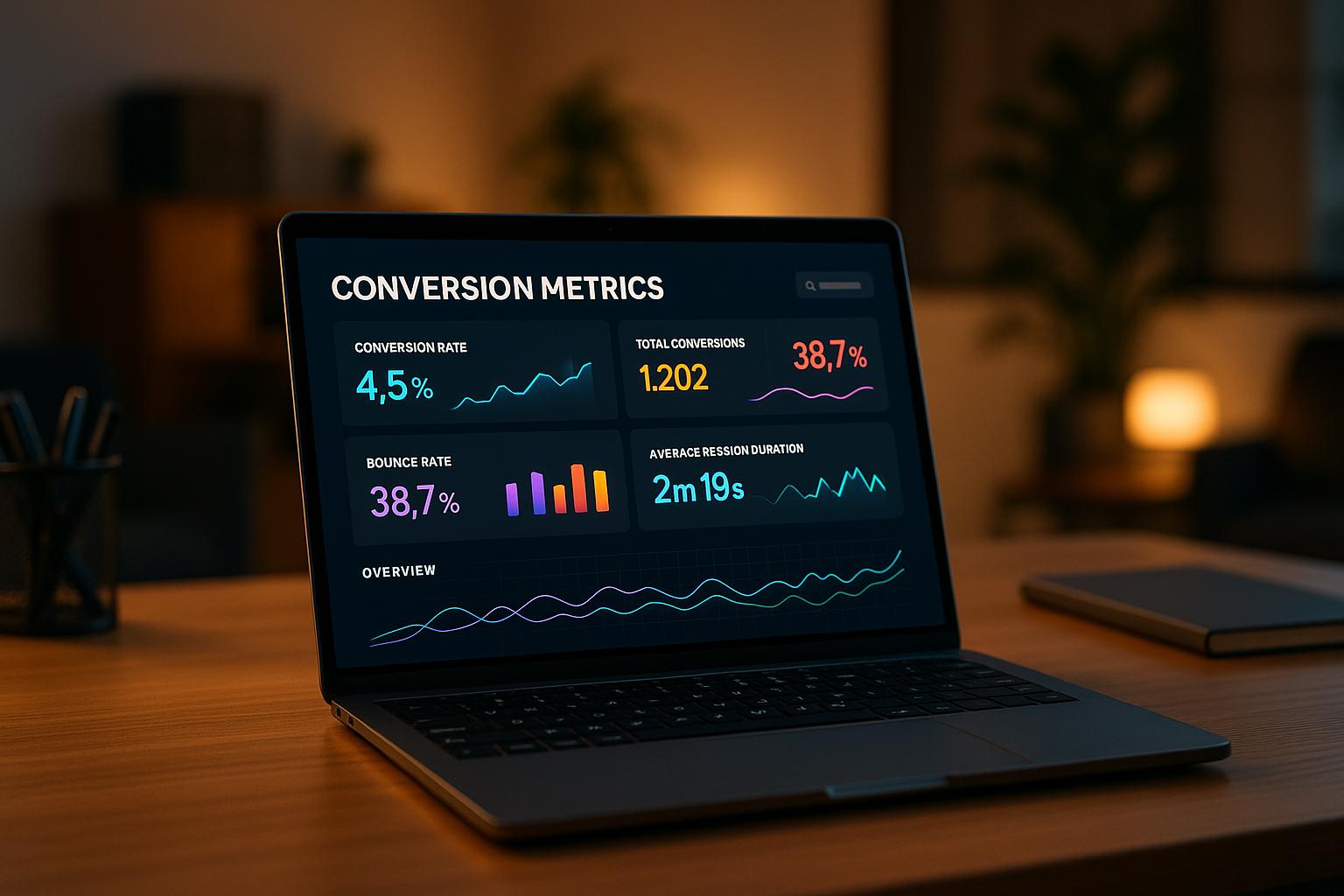
AI tools make tracking and improving website conversions faster and smarter. They analyze user behavior, automate data collection, and provide real-time insights to improve conversion rates. Businesses using these tools have reported up to a 30% increase in conversions. Key metrics tracked include conversion rate, return on ad spend (ROAS), customer lifetime value (CLV), bounce rate, and click-through rate (CTR).
Here’s what you need to know:
- AI simplifies CRO tracking by automating data analysis, identifying user trends, and running A/B tests faster than traditional methods.
- No-code platforms like Lideroo make these tools accessible to non-technical users, integrating features like drag-and-drop site building, content generation, and monetization tools.
- Top tools include Lideroo, Hotjar, Optimizely, and VWO, catering to businesses of all sizes with varying budgets and needs.
- Real-world results: Companies like Walmart and Slack have seen up to 25% boosts in conversions using AI-powered personalization and optimization.
AI tools are reshaping how businesses optimize their websites, offering actionable insights and faster results without requiring technical expertise. Whether you're a small startup or a large enterprise, these tools can help you make the most of your existing traffic while saving time and resources.
Key CRO Metrics Tracked by AI Tools
Main Metrics for CRO Success
AI tools rely on key metrics drawn from real user data to guide conversion rate optimization (CRO) efforts. These tools analyze performance in real-time, providing actionable insights to refine strategies and improve outcomes [1].
Conversion Rate is the percentage of visitors who complete a desired action, such as making a purchase, signing up, or downloading content. The average conversion rate sits around 2.63%, but top-performing sites often exceed 5% [3]. AI tools monitor this metric continuously, identifying trends and recommending adjustments to improve results.
Return on Ad Spend (ROAS) calculates how much revenue is generated for every dollar spent on advertising. AI tools automate this calculation by linking ad spend with revenue, making it especially valuable for businesses managing multiple ad campaigns.
Customer Lifetime Value (CLV) represents the total revenue a customer is expected to generate over their entire relationship with a business. Customer Acquisition Cost (CAC), on the other hand, reflects how much it costs to acquire a new customer. Together, these metrics reveal long-term profitability. AI tools predict CLV by analyzing purchase histories and behavioral data, helping businesses make smarter investment decisions.
Click-Through Rate (CTR) measures how often users click on specific elements, such as buttons or calls-to-action. By tracking CTR across different elements, AI tools pinpoint which features drive the most engagement and suggest optimizations.
Bounce Rate indicates the percentage of visitors who leave after viewing only one page. High bounce rates often highlight issues like slow page load times, irrelevant content, or poor user experience - areas AI tools can help diagnose and improve.
Average Session Duration tracks how long visitors spend on your site. Longer sessions typically signal greater engagement. AI tools analyze this alongside other metrics to provide a clearer picture of user behavior.
Revenue per Visitor (RPV) calculates the average revenue each visitor contributes. This metric helps businesses identify opportunities to maximize revenue from existing traffic.
For U.S. businesses, these metrics are essential for improving revenue and operational efficiency.
Why These Metrics Matter for U.S. Businesses
Tracking these metrics can have a direct impact on profitability, helping businesses optimize resources without the need for additional traffic [1].
Take cart abandonment, for instance - it’s a major challenge, with an average rate of nearly 70% across industries [3]. AI tools track abandonment rates and can automatically trigger recovery campaigns, potentially reclaiming thousands of dollars in lost revenue each month.
Page load speed is another critical factor. A one-second delay in loading time can reduce conversions by 7% [2]. For a business generating $100,000 in monthly revenue, that delay could cost $7,000 [2].
Even small tweaks can yield big results. For example, ADT increased conversions by 60% simply by changing their call-to-action from "Book a Free Survey" to "Get a Free Quote" [2]. AI tools test variations like these and automatically implement the most effective options.
Personalized product recommendations also drive revenue. Skincare brand Kiehl's, for example, boosted their average order value by 16% by adding a “You May Also Like” feature that suggests complementary products [3].
"CRO is not just a process, it's a mindset that should be applied at every stage of your business growth." - Lucas Kenji, Experimentation & CRO Manager at Trafilea [2]
001 AI, Technology & Conversion Optimization with Brian Massey
How AI Tools Simplify CRO Metrics Tracking
Tracking conversion rate optimization (CRO) metrics has traditionally been a time-consuming process, involving extensive data collection and analysis. AI-powered tools are changing the game by automating these tasks and providing actionable insights in real time. This shift allows businesses to act quickly, using predictive modeling and real-time data to make better decisions. With 61% of businesses expected to adopt AI-powered CRO methods in 2024, and 75% still struggling to make the most of their data, AI tools are stepping in to bridge the gap by turning massive amounts of information into clear, actionable strategies[4].
Automated Data Collection and Analysis
Gone are the days of manually collecting and interpreting CRO metrics. AI tools now handle this process seamlessly, gathering data from websites, ad campaigns, and user interactions. These systems continuously analyze the data to uncover patterns that might otherwise take weeks to identify. One of the standout benefits is real-time analysis - when bounce rates suddenly increase or conversion rates decline, AI tools can alert marketers immediately. On top of that, predictive modeling helps businesses anticipate user behavior, using historical data and trends to forecast which visitors are most likely to convert or which products are likely to perform best.
Take Netflix as an example. In 2025, the streaming giant used AI-driven predictive modeling to slash its churn rate by 30%[4]. By analyzing viewing habits, engagement levels, and user preferences, their system identified at-risk subscribers and automatically launched retention campaigns to keep them engaged.
AI-Powered A/B Testing and Personalization
AI doesn’t stop at data collection - it also enhances CRO strategies through advanced testing and personalization. Traditional A/B testing can be slow and labor-intensive, requiring manual setup and analysis over extended periods. AI simplifies this by automating the creation of variations, managing traffic distribution, and calculating results in real time. Companies leveraging AI for A/B testing have reported a 25% boost in conversion rates compared to traditional methods[4]. These tools can even run multiple tests simultaneously, optimizing everything from page layouts to call-to-action buttons.
AI-powered personalization takes things to the next level by analyzing individual user behavior, purchase history, browsing habits, and engagement data to deliver highly tailored experiences. For instance, Walmart saw a 25% jump in conversions in 2025 after implementing AI-driven personalization[4]. Similarly, Glamnetic, a beauty brand, achieved a staggering 120% increase in conversions in the same year by reducing their Time To First Byte (TTFB) from 550ms to just 85ms using AI optimization tools[6]. AI also enables dynamic content adjustments, ensuring recommendations, messaging, and offers are always relevant and personalized in real time.
Making Advanced CRO Accessible with No-Code Platforms
AI’s benefits are no longer limited to large corporations with technical teams. No-code platforms like Lideroo are breaking down barriers, making advanced CRO accessible to businesses of all sizes. These platforms allow users to implement AI-driven optimization strategies without needing any coding skills. With intuitive dashboards and built-in analytics, no-code tools track key metrics and integrate seamlessly with existing marketing systems.
Although 80% of businesses recognize AI as essential for improving online performance, many are held back by the complexity of traditional tools[4]. No-code platforms solve this problem by offering pre-built AI tools that are easy to implement. As a result, even small businesses and entrepreneurs can take advantage of advanced CRO strategies. The CRO market is expected to hit $1.8 billion by 2025, thanks in part to these user-friendly solutions[4]. These platforms also provide automated recommendations based on performance data and industry benchmarks, eliminating guesswork and ensuring smarter, data-driven decisions.
Modern no-code platforms can integrate with email marketing tools, social media advertising, and customer relationship management systems, offering a complete view of the conversion funnel. Together, features like automated data collection, dynamic testing, and no-code integration create a streamlined CRO strategy that’s transforming how businesses improve their conversion rates.
sbb-itb-dfa823a
Top AI Tools for Tracking CRO Metrics
AI tools have transformed how businesses track and improve conversion rates, offering tailored solutions to meet a variety of needs. Whether you're a small startup or a large enterprise, these tools can help you analyze and optimize your customer journey. The challenge lies in choosing the right tool that aligns with your technical skills, budget, and specific goals.
Overview of Leading AI Tools
Lideroo is a standout option for businesses seeking an easy-to-use, no-code website builder with integrated CRO tracking. Alongside its drag-and-drop editor and pre-built templates, Lideroo offers advanced analytics, SEO tools, and built-in monetization features. Its AI-powered content generation and auto-optimization capabilities make it a solid choice for boosting conversion rates without requiring technical expertise.
Fibr focuses on AI-driven personalization and creating landing pages at scale. By analyzing user behavior with AI CRO agents, it automatically optimizes conversion paths. For instance, ACT Fibernet used Fibr to refine their call-to-action messaging, resulting in a 12% increase in conversions and a 25% rise in new customer acquisitions [7]. Its pricing makes it accessible to small and medium-sized businesses.
Optimizely is a versatile platform designed for large-scale A/B testing and personalization. Known for its enterprise-level capabilities, it has earned an average 4.5-star rating on G2 from over 500 reviews [8]. Its predictive analytics and deep personalization features cater to organizations with complex testing needs.
VWO combines advanced testing tools with behavioral analytics. Features like heatmaps, session recordings, and multivariate testing are all included in one package. With similar G2 ratings to Optimizely, VWO is particularly effective for medium to large businesses looking for comprehensive testing solutions [9].
Hotjar offers a user-friendly way to gain insights into visitor behavior through heatmaps, session recordings, and feedback tools. It’s accessible to businesses of all sizes, with a free basic plan and premium options starting at $39 per month [10].
Crazy Egg specializes in visual behavior insights, providing heatmaps, scrollmaps, and session recordings. Starting at $24 per month and offering a free trial, it’s an affordable option for businesses wanting straightforward tools to analyze user behavior.
Dynamic Yield is ideal for businesses with omnichannel strategies, offering real-time personalization and automated testing. Its AI capabilities help optimize the customer experience across multiple touchpoints.
Wisepops shines in personalized onsite marketing. Retail brand émoi émoi used Wisepops to increase sales and boost average order value by 23% [5]. Lucie Poirier, their digital marketing manager, shared:
"Wisepops empowered us to weave personalized touchpoints throughout the customer journey, seamlessly and without involving our technical team. This tool allowed us to translate the warmth and personal attention of our physical boutiques into the digital space, creating a uniquely émoi émoi online experience that truly resonates with our brand values of love and human connection." [5]
Tool Comparison
| Tool | Starting Price (USD) | Best For | Key AI Features | Business Size |
|---|---|---|---|---|
| Lideroo | Free (Starter: $53/month) | No-code website building with CRO tracking | AI content generation, auto-optimization, advanced analytics | Small to medium businesses |
| Fibr | Affordable | AI-driven personalization, bulk landing pages | AI CRO agents, automated optimization | Small to medium businesses |
| Optimizely | Enterprise pricing | Large-scale A/B testing and personalization | AI-powered experimentation, predictive analytics | Large enterprises |
| VWO | Mid-tier pricing | Comprehensive testing and analysis | AI-driven insights, automated testing | Medium to large businesses |
| Hotjar | Free (Premium: $39/month) | User behavior analysis | AI-powered heatmaps, session analysis | All business sizes |
| Crazy Egg | $24/month | Visual behavior insights | AI-enhanced heatmaps, automated reporting | Small to medium businesses |
| Dynamic Yield | Enterprise pricing | Omnichannel personalization | Real-time AI optimization, predictive modeling | Large enterprises |
| Wisepops | Varies | Onsite personalization | AI-driven targeting, automated campaigns | Small to medium businesses |
| OptiMonk | $19/month (Free plan available) | Exit-intent technology | Behavioral targeting, automated lead capture | Small to medium businesses |
Studies show that businesses using AI-driven CRO tools can see an average 15% boost in conversion rates, with some achieving up to 25% improvements [8]. For those just starting out, platforms like Lideroo, Hotjar, or Crazy Egg offer beginner-friendly options with intuitive interfaces and helpful onboarding experiences.
Best Practices for Using AI CRO Tools
To get the most out of AI CRO tools, it's crucial to set clear goals, maintain consistent oversight, and adhere to privacy regulations. These steps ensure your investment translates into tangible results rather than becoming just another tool collecting dust in your marketing arsenal. Let’s dive into the essentials.
Setting Clear Goals and KPIs
Start with specific, measurable targets, like boosting checkout conversion rates by 15% or cutting cart abandonment by 20% within three months [12]. Your metrics should align with the stages of your sales funnel:
- Awareness: Track click-through rates.
- Engagement: Monitor bounce rates.
- Purchase intent: Focus on cart abandonment rates [12].
This approach allows AI tools to zero in on the behaviors that matter most to your goals.
A great example of goal-setting comes from the Obama 2012 campaign. Their team honed in on a single objective: increasing donations through their website. After identifying that a complex donation form was discouraging users, they simplified it by reducing visible fields and streamlining the process. The result? A 5% increase in conversions [12].
To make your goals actionable, use S.M.A.R.T. KPIs informed by historical data. For instance, aim to improve click-through rates or reduce bounce rates to boost revenue. Businesses leveraging AI-powered personalization tools often see a 10–15% increase in revenue on average [11][13]. Additionally, analyze visitor data to refine your optimization strategies and help AI tools spot actionable trends faster [12].
Regular Monitoring and Updates
AI thrives on real-time insights, but ongoing monitoring is key to ensuring your optimization efforts stay on track. Keep an eye on both macro conversions (like sales or sign-ups) and micro conversions (such as email subscriptions or content downloads) to get a full view of your conversion funnel [17]. This broader perspective helps pinpoint bottlenecks that might otherwise go unnoticed.
Before launching any tests, double-check your parameters. Ensure tracking codes are functioning correctly and validate cross-device compatibility to avoid errors that could skew your data [17]. A small setup mistake can derail weeks of work.
Supplement AI insights with tools like heatmaps and session recordings to understand the "why" behind user behaviors. Pair this with continuous A/B testing rather than occasional experiments, as ongoing testing gives AI algorithms more data to refine their recommendations [17].
Keep a detailed log of experiments and their outcomes. This helps you avoid repeating unsuccessful tests and provides a roadmap for future strategies. A testing calendar can also help you track seasonal trends and long-term patterns, offering valuable insights for your optimization efforts.
Data-driven adjustments are critical. For example, content tailored to specific buyer personas often generates 6× more engagement when targeting cold leads [17]. Update these personas regularly based on new insights, as your audience's preferences and behaviors will evolve over time. Remember, the effectiveness of your AI tools depends heavily on the quality of the customer data they analyze.
Compliance with U.S. Data Privacy Laws
With several states enacting new privacy laws in 2025, staying compliant is more challenging - and more important - than ever [15]. Businesses using AI CRO tools must remain vigilant as regulations continue to evolve.
To navigate this landscape, establish cross-functional review processes that include cybersecurity, legal, data science, and procurement teams. As Joseph J. Lazzarotti from Jackson Lewis P.C. points out:
"It's this constant sense of governance - risk and compliance processes that should take place whenever you're dealing with these technologies. If there was one goal I would recommend for next year, that would be more collaboration between the stakeholders [IT, legal, HR, the business area deploying the tech] when rolling out these kinds of tools." [14]
Adopt strict data sourcing policies to ensure third-party datasets are accurate and lawfully obtained [16]. Vendors should verify the integrity of their data to avoid introducing errors or risks into your optimization efforts.
Implement Privacy-by-Design principles when setting up your AI CRO tools [15]. This means integrating privacy protections from the outset rather than treating them as an afterthought. Consider investing in Privacy-Enhancing Technologies (PETs) to gain insights while minimizing data exposure.
Stay updated on U.S. privacy regulations, including state-specific laws and protections for minors. Regularly review your compliance measures to ensure they align with the latest requirements.
Finally, update your incident response plans to address AI-specific risks like model poisoning, adversarial inputs, and data drift [16]. These threats are unique to AI systems and demand specialized strategies beyond traditional cybersecurity measures.
Conclusion
AI-powered CRO tools are changing the game for businesses looking to track and improve their conversion metrics. These tools allow companies to automate data collection, deliver personalized user experiences at scale, and spot optimization opportunities in real time. In fact, AI-driven strategies have been shown to boost conversion rates by as much as 30% in tested scenarios [19]. This shift signals a future where CRO becomes more streamlined and data-driven than ever.
One of AI's biggest advantages is its ability to process behavioral data instantly and make optimization decisions on the fly. For example, Slack has used AI to tailor upsell strategies, leading to a 25% increase in average revenue per user. Similarly, Cadbury leveraged AI personalization to achieve a 33.6% increase in conversion rates in the Indian market [20].
Building on these achievements, no-code platforms like Lideroo make it easier than ever to deploy AI-driven strategies. With intuitive interfaces and features like AI-powered content generation, these platforms simplify the process of optimizing conversions, removing much of the guesswork.
The key to success? Start small and scale quickly. Define clear, measurable goals for your AI systems, and remember that while AI enhances traditional CRO efforts, its true potential is unlocked when paired with human creativity and oversight [20].
As Jeff Bezos famously said, "If you double the number of experiments you do every year, you are going to double your inventiveness" [18]. AI tools make it easier to run more experiments, gather deeper insights, and implement optimizations faster than ever before. The real question isn’t whether to embrace AI for CRO - it’s how soon you can get started.
FAQs
How can AI tools help improve conversion rate optimization (CRO) for users without technical skills?
AI tools have made conversion rate optimization (CRO) easier and more approachable for everyone, even for those who lack technical skills. Many of these tools come with user-friendly, no-code interfaces that simplify tasks such as A/B testing, website personalization, and analyzing performance metrics.
With the help of AI-powered insights and recommendations, users can pinpoint what resonates most with their audience and make informed decisions based on data. Features like drag-and-drop editors, automated suggestions, and pre-designed templates allow marketers to fine-tune their websites with ease, saving time while boosting results.
What key metrics do AI tools monitor to improve website conversions?
AI tools keep track of several important metrics to help improve website conversions. These include:
- Conversion rate: This measures the percentage of visitors who take a desired action, such as making a purchase or signing up for a newsletter.
- Bounce rate: Tracks the percentage of visitors who leave your site after viewing just one page.
- Average session duration: Shows how much time, on average, visitors spend on your site.
- Pages per session: Indicates the average number of pages a user views during a single visit.
- Cart abandonment rate: Reflects the percentage of users who add items to their cart but leave without completing the purchase.
- Customer lifetime value (CLV): Estimates the total revenue a business can expect from a single customer over their entire relationship with the brand.
- Click-through rate (CTR): Measures the percentage of users who click on a specific link or call-to-action.
By diving into these metrics, AI tools can offer practical insights to enhance user experiences, minimize drop-offs, and guide smarter decisions that lead to higher conversion rates.
How can AI-powered tools help small businesses improve their conversion rates?
AI-powered tools are transforming how small businesses improve their conversion rates by handling complex tasks like data analysis and decision-making with ease. Unlike older methods, AI can sift through massive amounts of data in real time, spot trends, and adjust user experiences on the fly to increase engagement and drive conversions.
With these tools, small businesses can create personalized customer interactions, experiment with multiple strategies at once, and make quicker, data-backed decisions - all without needing a large team or budget. This means smoother operations and a stronger position in today’s fast-moving market.