
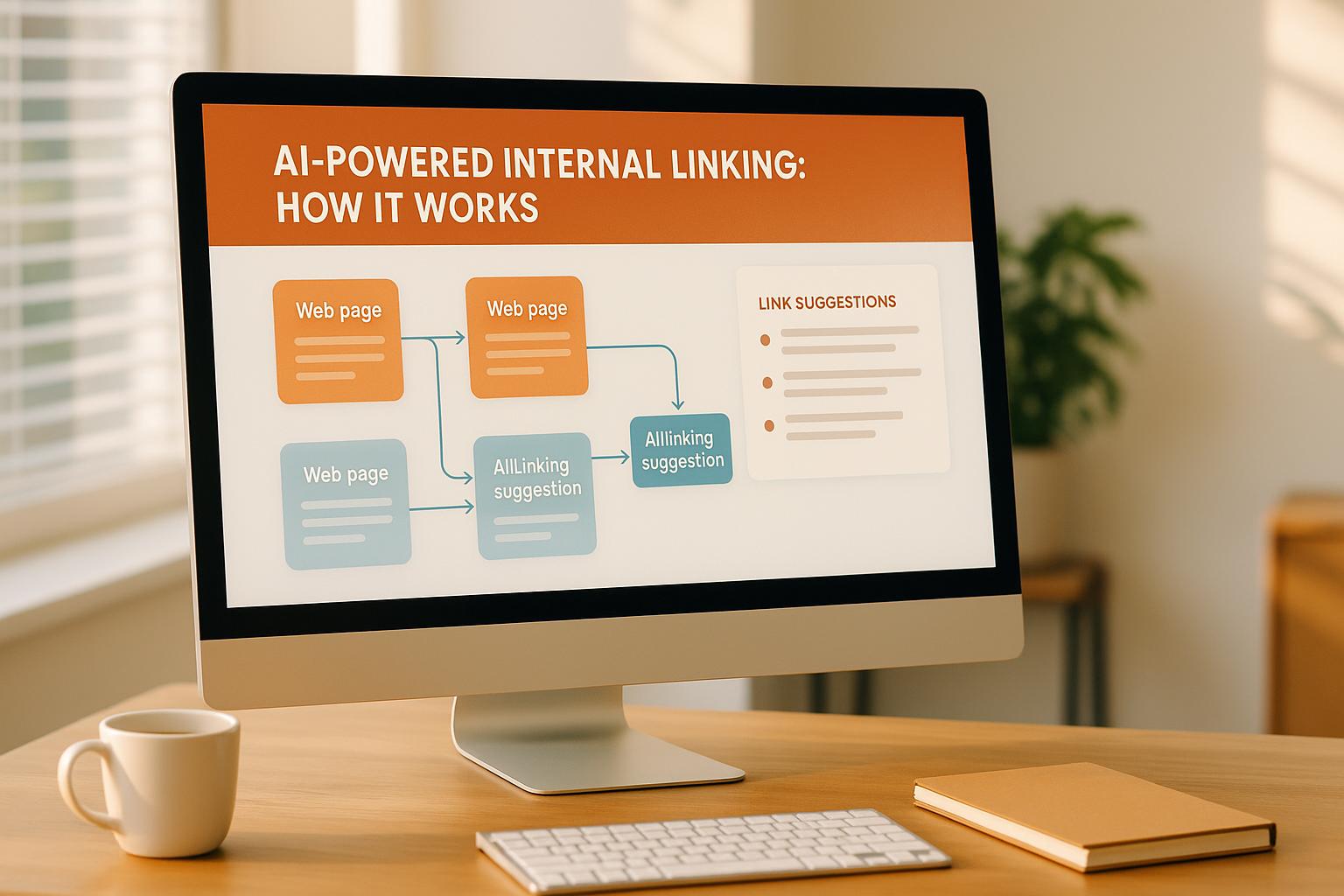
AI-powered internal linking simplifies the task of connecting your website's pages by automating the process. It uses advanced algorithms and Natural Language Processing (NLP) to analyze your content, identify meaningful relationships, and create contextual links that improve SEO and user experience. Here's what you need to know:
- Boosts SEO: Helps search engines discover, index, and rank your pages by improving site structure and spreading page authority.
- Saves Time: Automates manual tasks like finding related pages and optimizing anchor text.
- Improves Relevance: Links are based on semantic relationships, not just keywords, ensuring logical connections.
- Dynamic Updates: Adapts to new content, integrating it into your link structure without manual effort.
To implement this, prepare your site with a content audit, configure AI tools for link density and anchor text variation, and combine automation with human review for accuracy. Track key metrics like crawl frequency, click-through rates, and page authority to refine your strategy over time.
AI-powered internal linking transforms how you manage your site, making it easier for users to navigate and search engines to understand.
🔗 How I Boost Rankings With AI-Powered Internal Linking for SEO (in Under 5 Minutes)
How AI-Powered Internal Linking Works
AI-powered internal linking operates with a level of efficiency that manual methods simply can't match. By leveraging advanced processes, this technology creates intelligent and meaningful connections between your content.
Content Analysis Using Natural Language Processing (NLP)
At the core of AI-driven internal linking is Natural Language Processing (NLP). This technology doesn’t just skim through content for keywords - it dives deeper, analyzing structure and identifying key entities while mapping out relationships between concepts.
For example, if you have one article on "email marketing strategies" and another on "newsletter automation", NLP can spot the connection between these topics, even if they don’t share identical keywords. It picks up on context clues and understands subtle nuances, like distinguishing "apple" the fruit from "Apple" the tech company.
This ability allows NLP to suggest links that feel natural and genuinely enhance the reading experience. For instance, an article focusing on "conversion rates" that mentions "landing pages" and "A/B testing" might trigger link suggestions to other content on those topics, creating a seamless flow for readers. From there, the AI groups related pages into meaningful topic clusters.
Semantic Matching and Topic Clustering
After analyzing your content, the AI shifts to semantic matching, which organizes pages based on underlying themes and concepts. This process forms topic clusters - groups of related content centered around a main theme.
For instance, a business blog might have clusters around themes like "marketing", "sales", or "product development." Within these clusters, the AI identifies pillar content (in-depth guides) and supporting articles. These clusters strengthen your site’s authority by presenting it as a comprehensive resource on specific topics.
The AI also ensures that links are added strategically, avoiding over-optimization. Instead of repeating the same anchor text for every link, it varies the phrasing based on the semantic relationship between pages. For strong connections, it may suggest direct links, while weaker ties might result in more subtle references. This balanced approach not only improves user experience but also aligns with search engine best practices.
Anchor Text Optimization
Once the AI has established topic clusters, it fine-tunes the presentation of links by optimizing anchor text - the clickable words used in internal links. This step balances SEO benefits with readability and user experience.
Rather than forcing awkward phrases into your content, the AI identifies natural opportunities for linking. For example, a sentence like "Our guide covers social media best practices" could be transformed into "Our social media best practices guide covers everything you need to know." The result? Smooth, user-friendly links that don’t disrupt the flow of your writing.
The AI also ensures diversity in anchor text. If multiple links point to a page on "SEO fundamentals", it might use variations like "SEO basics", "search engine optimization guide", or "fundamental SEO principles." This variety not only feels more natural to readers but also avoids triggering spam signals with search engines.
To make links even more effective, the AI tailors anchor text to reflect the target page’s focus. For instance, when linking to a comprehensive guide on content marketing, it might use "complete content marketing strategy" instead of generic terms like "click here." Over time, the system refines its choices by analyzing user behavior - adjusting based on which variations drive higher engagement or click-through rates.
Together, these processes create a dynamic internal linking structure that evolves as your content grows, making it easier for readers to navigate your site and for search engines to recognize your authority on key topics.
Setting Up AI-Powered Internal Linking on Your Website
Setting up AI-powered internal linking requires careful preparation, proper configuration, and ongoing monitoring to ensure the system works well with your content and goals.
Preparing Your Website for AI Automation
Before diving into AI tools, your website needs to be in good shape.
Start with a content audit. Go through every page on your site to understand what you have. Identify cornerstone content, find pages covering similar topics, and note any gaps in your content. This audit becomes the foundation for your AI-powered linking strategy.
Next, review your existing links for orphan pages and broken links. Orphan pages, which have no internal links pointing to them, are essentially invisible to users and search engines. These are perfect candidates for AI-driven linking. Use analytics or crawling tools to locate and fix broken links, as AI tools perform best when they’re working with a clean slate.
Take a close look at your site architecture. Your pages should follow a logical hierarchy, with related content grouped together. A chaotic structure can make it harder for AI to identify meaningful connections between pages. While a complete overhaul isn’t necessary, some organization helps the AI better understand your content relationships.
Finally, make sure your content management system (CMS) can handle the changes AI tools will suggest. Some platforms may have limitations on how links can be added or updated, which could slow down your automation efforts.
Getting these basics right ensures that your AI tools have a solid foundation to work from.
Configuring AI Tools for Internal Linking
Once your website is ready, it’s time to configure the AI tools to meet your needs.
Set the link density to 2-5 links per 1,000 words. Too few links mean missed opportunities to guide readers, while too many can overwhelm users and reduce the value of each link.
Adjust the topical relevance thresholds to control how closely related two pieces of content must be for the AI to suggest a link. If the threshold is too low, you’ll get weak connections that don’t help users. Set it too high, and you might miss good linking opportunities. Start with moderate settings and tweak them as needed.
Use anchor text variation rules to avoid repetitive or overly optimized link text. Configure the AI to use different phrases for the same target page and set guidelines for how specific or general the anchor text should be. For example, opt for descriptive phrases like "guide to email marketing tools" instead of generic terms like "click here."
Prioritize your most important pages with content prioritization settings. High-value pages - like landing pages, comprehensive guides, or high-traffic articles - should receive more internal links than less critical ones.
Set up exclusion rules to avoid linking to pages that don’t benefit from internal links, such as legal disclaimers, contact forms, or technical documentation. This keeps your linking strategy focused and relevant.
Combining Automation with Human Review
Even with AI tools in place, human oversight remains essential to ensure your internal linking aligns with your overall strategy. While full automation might sound tempting, the best results come from combining AI with human judgment.
Create a review workflow where AI suggestions are approved before implementation. This allows you to filter out links that might be technically correct but don’t align with your goals. For instance, linking a beginner’s guide to advanced technical content might confuse readers, even if the topics are related.
Ensure brand alignment by reviewing links to support your content strategy and user journey. If you’re steering readers toward specific conversion pages or a content series, human oversight is key to keeping the AI’s suggestions on track.
Regular quality control is critical as your system grows. Periodically review the links being created to ensure they meet your standards. If you notice recurring issues, adjust your AI settings accordingly.
Finally, human review ensures contextual accuracy. While AI can identify topical connections, it might miss subtle nuances, like linking a serious article to lighthearted content. Such mismatches can disrupt the user experience.
Consider a graduated automation approach. Start by having the AI suggest links for manual review and implementation. As you refine the system and gain confidence in its accuracy, you can gradually increase automation for content types or link suggestions that consistently meet your standards.
sbb-itb-dfa823a
Tracking and Improving AI-Driven Link Performance
Once your AI-powered internal linking system is live, the next step is to track its performance. Monitoring the right metrics will help you determine whether your links are guiding users effectively and boosting your SEO efforts.
Important Metrics to Track
After automating your internal linking, it’s crucial to measure its success using specific performance indicators.
Crawl Frequency:
Crawl frequency shows how well-connected your site is. Use Google Search Console to monitor how often bots visit your pages. Frequent crawls and shorter intervals typically indicate better connectivity.
Organic Traffic Patterns:
Keep an eye on changes in traffic, both for individual pages and your site overall. This helps you gauge the impact of your linking strategy.
Session Duration and Bounce Rates:
Improved session duration and lower bounce rates suggest a more engaging link structure. When users follow internal links, they’re more likely to explore additional content, spending more time on your site.
Page Authority Distribution:
Understanding how link equity is distributed across your site is essential. Tools like Ahrefs or Moz can track shifts in page authority. A well-designed AI linking strategy should gradually enhance the authority of key pages without overly concentrating it on a single page.
Click-Through Rates on Internal Links:
Tracking click-through rates for your internal links offers direct insight into their effectiveness. Most analytics platforms can measure this, helping you identify whether users find your links relevant. Low click-through rates might indicate issues with anchor text or link placement.
Indexation Rates:
Monitor the indexation of pages, especially those that were previously orphaned or poorly connected. Higher indexation rates suggest that search engines are now discovering and indexing content that was previously hard to find.
Using AI Data for Ongoing Improvements
AI tools don’t just automate linking - they also provide valuable data to help you refine your strategy over time.
Pattern Recognition:
AI can analyze user behavior to identify which types of content connections work best. Insights from clicks and session durations can guide future link recommendations.
Content Gap Identification:
Advanced AI tools can highlight topics that users are searching for but aren’t well-covered on your site. This data can inform new content creation or better linking to existing pages.
Seasonal Performance Tracking:
AI tools can spot seasonal trends in user behavior, helping you adjust link priorities to match changing content preferences throughout the year.
User Journey Mapping:
Mapping how users navigate your site reveals both effective pathways and areas where users may get stuck. Strengthening these routes with better links can improve the overall experience.
A/B Testing Capabilities:
Many AI platforms allow for A/B testing, letting you experiment with different anchor texts, link densities, and placements. These tests help identify the most effective strategies for your audience.
Competitive Analysis Features:
Certain AI tools also offer competitive analysis, showing how your internal linking compares to industry standards. This can help pinpoint areas for improvement and guide your strategy.
Running Regular Audits
Consistent audits are essential to keep your AI-driven linking strategy effective and error-free.
- Monthly Reviews: Check link quality regularly to catch any issues early.
- Quarterly Audits: Dive deeper to identify broken links, over-optimization, or other problems.
- Annual Assessments: Align your linking strategy with your broader business and SEO goals.
Be cautious of over-linking - pages with too many links, repetitive anchor text, or irrelevant connections can harm user experience and SEO. Regularly compare current performance metrics with historical data to spot any declines in engagement or traffic.
Document your findings and create actionable plans to address any problems. This ongoing process will help you fine-tune your internal linking strategy and maintain steady SEO growth.
For those using Lideroo to build their website, integrated SEO tools make it easier to track these metrics and adapt your linking strategy as your business evolves.
Conclusion: Improving Your Website with AI-Powered Internal Linking
AI-powered internal linking takes the hassle out of manual, time-intensive processes by using smart automation to strengthen the connections between your website's pages. This technology not only makes your site easier for search engines to navigate but also enhances the experience for your visitors.
Main Takeaways
One of the standout benefits of AI-driven linking is its ability to use semantic content analysis instead of just matching keywords. With natural language processing, these systems grasp context, understand relationships between topics, and even anticipate user intent - something manual linking struggles to achieve at scale.
Automation is another game-changer. By processing your entire site in just minutes, AI tools can identify and update links dynamically as new content is added. This leads to improved SEO performance by increasing crawl frequency, distributing page authority more effectively, and building clear topical clusters that search engines can easily interpret.
Visitors also benefit from more relevant and helpful link suggestions. By analyzing user behavior, AI tools can recommend links that guide users to content they find valuable, keeping them on your site longer and reducing bounce rates.
Beyond automation, these tools offer valuable data-driven insights. They can spot patterns, reveal gaps in your content, and map user journeys, helping you understand how visitors interact with your site and where you can make improvements.
Use these insights to make meaningful changes that enhance your website's performance and usability.
Next Steps
To start, perform an audit of your internal linking structure. Look for pages that are disconnected or poorly linked to others. This will give you a clear baseline to measure how AI-powered linking improves your site.
Select an AI-powered platform that aligns with your website's architecture. For example, Lideroo offers built-in AI-driven internal linking features that integrate seamlessly with your SEO strategy, helping your site grow alongside your content.
Before rolling it out across your entire site, try implementing AI-powered linking on a smaller section. This trial run will help you fine-tune the settings and see how the system works with your specific content types.
Once implemented, set up regular monitoring to track key metrics like crawl frequency, organic traffic, session duration, and click-through rates on internal links. Keeping an eye on these numbers ensures the system continues to deliver results as your site evolves.
Lastly, remember that while AI can handle the heavy lifting, human oversight is essential. Your strategic input ensures that the links created align with your business goals and meet the needs of your users. Together, automation and human insight can take your site's internal linking to the next level.
FAQs
How does AI-powered internal linking improve a website's SEO?
AI-driven internal linking takes the hassle out of manually creating links by automatically identifying and adding relevant connections across your website. This not only saves time but also ensures your site maintains a consistent structure, making it easier for search engines to understand and navigate.
When your content is organized with a clear hierarchy, search engines can crawl and index your pages more efficiently, which may improve your rankings. Plus, strategically placed internal links enhance the user experience by simplifying navigation, keeping visitors engaged, and even encouraging actions like purchases or sign-ups, ultimately boosting your site's overall performance.
How can I prepare my website for AI-powered internal linking?
To get your website ready for AI-powered internal linking, start by making sure your site is easy to navigate and well-structured. Organize your pages logically, use clear and descriptive URLs, and set up a sitemap. These steps help the AI grasp how your content is connected and make smarter linking suggestions.
Next, fine-tune your content. Sprinkle relevant keywords naturally throughout your pages and ensure every page has a clear focus. This helps the AI spot meaningful connections and recommend useful internal links. Keeping your content fresh and up-to-date also boosts its value and link potential.
Lastly, dig into your website's analytics. Look for high-performing pages and areas where users might benefit from additional links. This data can guide you in using AI tools to improve navigation and give your SEO a boost.
How can I track and improve the performance of AI-powered internal links over time?
To keep an eye on and improve AI-driven internal links, pay attention to essential metrics such as increased traffic to linked pages, smoother user navigation, and how link equity is spread across your site. Tools like analytics platforms and site audits can help spot broken links, orphaned pages, or areas that aren't performing as well as they should.
AI tools can simplify this process by automating tasks and offering insights and suggestions for ongoing improvements. By reviewing these insights regularly, you can ensure your internal linking strategy boosts SEO performance while creating a smoother experience for your users.